role
designer (UXD)
I owned the UX role within a cross-functional team comprised of a PM, developers and business stakeholders
goal
increase recruiter autonomy, increase candidate conversion, decrease financial operations review time
problem
sunk costs, lost candidates
Recruiters have limited autonomy in negotiation salaries, causing delays when responding to candidates.
Competing offers from other companies draw candidates away, a sunk cost of recruiter time.
users
candidates
Candidates range in experience, motivations and expectation and often have competing offers, using it as leverage in negotiating. Each candidate has different expectations for based, bonus and equity for their compensation.


recruiters
The 'power-users' of the product, recruiters are empathetic, curious and always willing to negotiate on behalf of their candidates. They are well versed in the platform capabilities and work to push beyond constraints imposed by the platform.
operations (Ops) team
The Ops team is focused on maximizing financial viability for the company. Their main pain point is sunk time reviewing requests that are generally unfeasible. Unfortunately, recruiters have no other choice but to ask, even if they doubt a positive outcome.

design exploration
the technical requirements presented an A.I. solution that can approve compensation in real time
as-is state
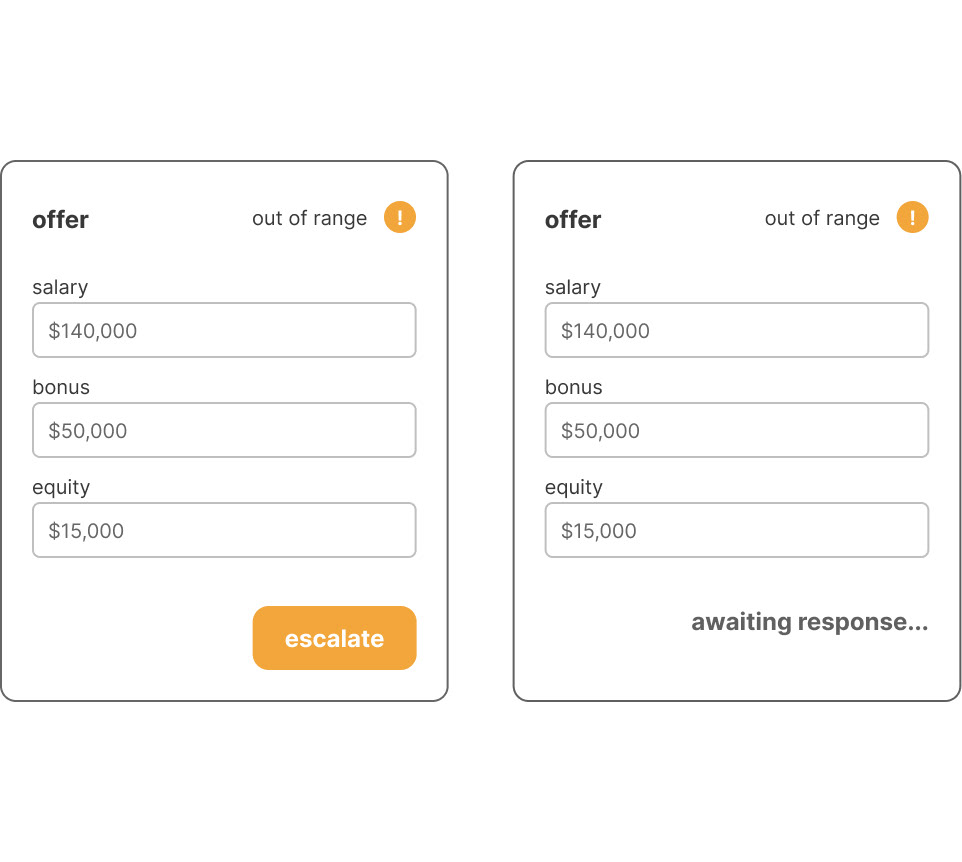
If an offer is out of range, recruiters can escalate it to the Ops team. After this step, they must wait for a response.
The offer can be altered to bring it in range, but this is undesired since Ops are reviewing.

user testing
three prototypes explored workflows to achieve a positive response - tested with 11 users in hour-long sessions, across four geographies
Tasking recruiters to push compensation out of range, we observed how they perceived the new feature. The sessions settled questions from the cross-functional team and stakeholders:
- will recruiters discover the feature
- will recruiters discover the feature
- How many times can / should a recruiter increase compensation
- will they trust the output and share it with their candidate
- will they appreciate the difference from contacting the Ops team as they have done in the past
Recruiters validated the integration discoverability (1), with all 11 recognizing the change in button text from their original workflow.
After each call, recruiters recognized diminishing returns(2) and admitted to pushing until increases to compensation ceased.
After each call, recruiters recognized diminishing returns(2) and admitted to pushing until increases to compensation ceased.
Several recruiters stated that they would still reach out to Ops directly, though admitted they would use the feature to check for an increase, withholding that information from their candidate.
All recruiters recognized the value of having real-time confirmation(3) if they got 60-80% of their target.
All recruiters recognized the value of having real-time confirmation(3) if they got 60-80% of their target.
1. discoverability
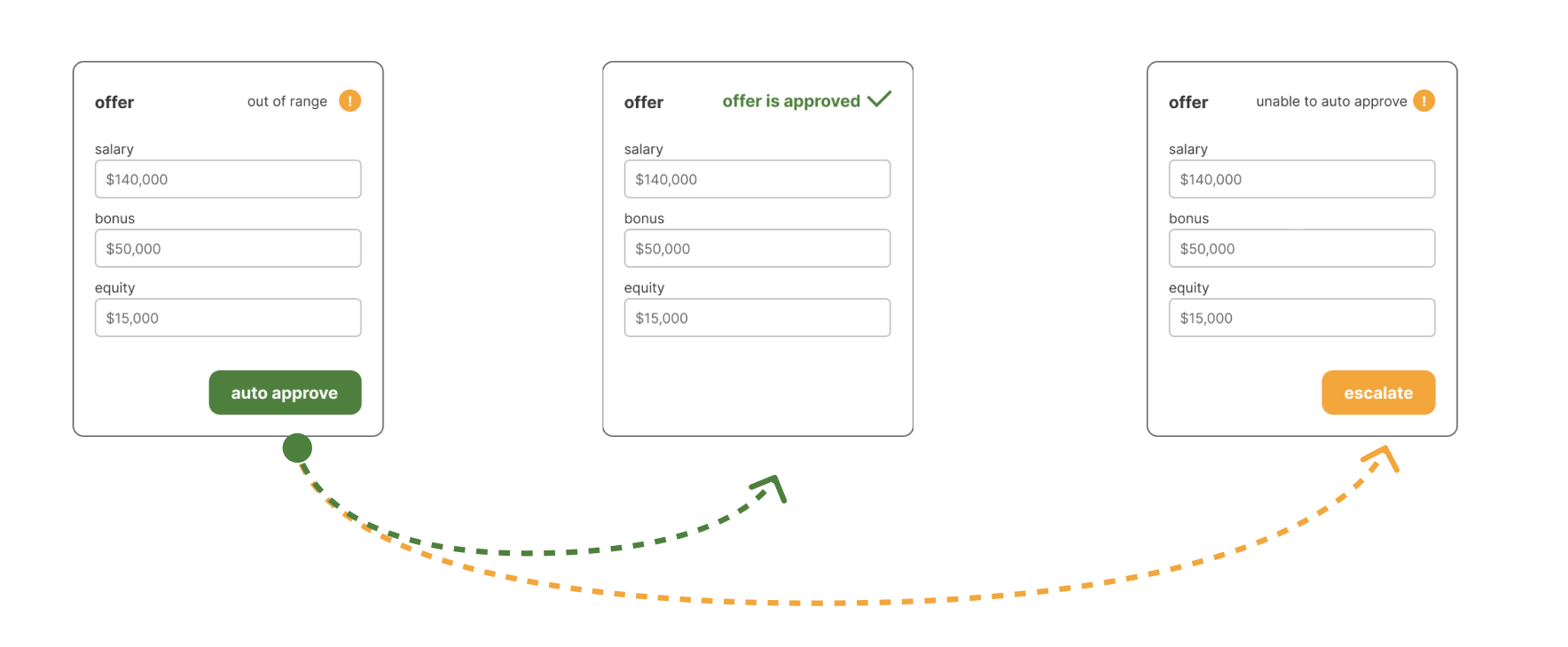
despite initial hesitation from the team over 'poor discoverability' the simple 'auto-approve' change in button text was kept since all recruiters recognized the change.
2. limited attempts
Given how recruiters thought about the new feature, we decided to limit users to two calls.
After the second call, the auto-approve would be replaced by the escalate button.
Users who continued to escalate would be asked to confirm, since the Ops team would now dedicate time to review
3. achieving value for recruiters
Recruiters found the feature and used it - but did they find it useful? Because our simulated the back-end behavior and output, all participants noted the importance of getting 'legitimate' responses.
If proposed compensation exceeds by 20% and auto approve fails, recruiters maintained that they would still contact Ops in hopes of reaching their goal.
Since the auto-approve logic uses an ML algorithm, responses can be fine-tuned using both external and internal parameters For example, if a data analyst in Berlin with 3 years of experience is requesting €50,000 more, we can factor in salary ranges in Germany, while maintaining a desired margin.

outcomes
recruiters have autonomy in negotiation, meeting candidate expectations faster
candidate expectations are met faster, leading more of them to accept offers
Ops team spends less time reviewing proposals